


Signs and Symptoms
- Full or heavy sensation in the body part at risk
- Painless or painful swelling
- Tightness in the skin
- Difficulty wearing clothes, tight jewellery
- Long standing swelling causes skin changes and the tissue becomes thickened and hard
Stages of Lymphoedema
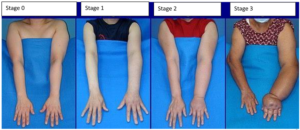
As per International Society of Lymphology (ISL) Stage 0:
A subclinical state where swelling is not evident despite impaired lymph transport. This stage may exist for months or years before oedema becomes evident
Latency stage
Reduced transport capacity/compromised system
No clinical signs or symptoms
Stage I:
Early onset of the condition where there is accumulation of tissue fluid that subsides with limb elevation. Oedema may be pitting at this stage or not
Spontaneously reversible stage
Soft oedema or mild pitting
Elevation reduces swelling completely
No skin/tissue changes
Stage II:
Limb elevation rarely reduces oedema
Pitting oedema which does not reduce with limb elevation
Spontaneously irreversible stage
Positive Stemmer sign
Frequent infections or Cellulitis
Skin tissue changes – fibrosis or hardening of tissue, nonpitting, in late Stage II
Late Stage II:
may or may not be pitting as tissue fibrosis is more evident
Stage III:
Lymphostatic elephantiasis
Positive Stemmer sign
tissue is hard (fibrotic) and pitting is absent
skin changes thickening, hyperpigmentation
Extreme increase in volume and deep skin folds
Hard, thickened noncompressible skin
Skin changes include papillomatosis
Hyperkeratosis
Stage as 3 if papillomatosis and hyperkeratosis are present, even if
large amount of oedema is not present
Who is at risk?
Any person that went through cancer related treatments, cosmetic surgery, orthopedic surgery, vascular conditions (phlebology), obesity, family history of lymphoedema, untreated wounds and cellulitis. Treatment is aimed at reducing the swelling and education about self-management.
What causes lymphedema?
Treatment
Complete decongestive therapy
- Manual Lymphatic drainage
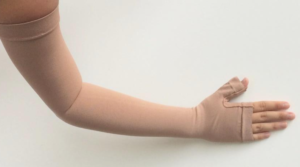
- Compression
- Light exercise
- Self management
- Dietary adjustments
Signs and Symptoms
- Feeling of heaviness in the legs
- Bruise easily
- Struggling to loose weight
- Swelling of the affected body part/s

What causes Lipoedema?
It is a hereditary and/or genetic condition
Treatment
Complete decongestive therapy
Manual Lymphatic drainage
Compression
Light exercise
Self-management
Additional treatments may include intermittent pneumatic compression therapy (IPC), and laser or lymph taping. Several surgical interventions are also available for the management of lymphedema, all of which require long-term post-surgical compression therapy.
Lipoedema Self-mangement
Lipedoema is a chronic condition that needs an individual holistic treatment approach focusing on the patient’s needs and enabling daily functioning. Thereby self-management is very important.
Compression therapy is an integral part of the treatment plan for all these conditions by using garments or short stretch bandages.
In addition, regular exercises, most suitable for each patient, have to be integrated into daily life.
Furthermore, relaxation (yoga, mindfulness training) and psychotherapy are helpful. Liposuction is suitable only for some patient groups.
Optimizing the health situation, avoiding risk factors and continuing lipoedoema treatment is essential to managing lipoedoema.